
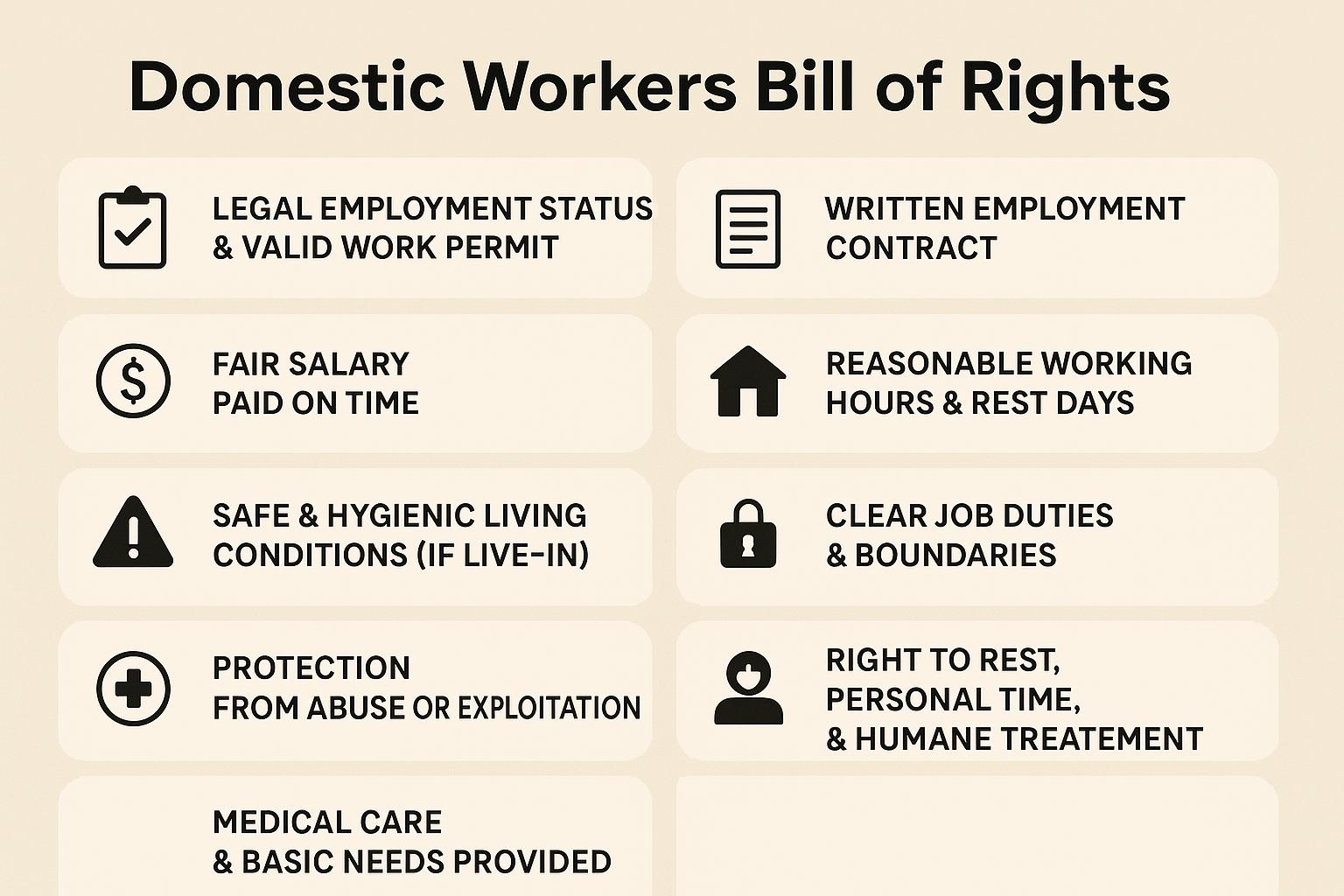
Every household that employs a helper should operate not as merely an employer-employee arrangement, but as a partnership built on respect, dignity, and fairness. A domestic workers bill of rights outlines the fundamental standards helpers should expect — and employers must provide — to ensure a safe, respectful, and stable work environment. This “bill of rights for domestic workers” serves as a guideline for ethical treatment and long-term mutual trust.
Such a bill is not just a legal document: it’s a moral and practical commitment to protect human dignity. Treating helpers fairly improves their motivation, loyalty, and performance — and creates a harmonious home for everyone.
What Should a Domestic Workers Bill of Rights Cover?
A comprehensive domestic workers bill of rights should include several key areas: legal protections, basic human rights, working conditions, privacy, welfare, and transparent communication.
Legal & Contractual Protections
- A written employment contract specifying job scope, salary, payment schedule, rest days, and termination terms.
- Valid work permit or equivalent legal authorization (especially for foreign domestic workers), to avoid undocumented employment and related penalties.
- Clear documentation (passport, permit, contract copy, employer identity) ensuring legality and traceability.
- Fair and timely payment on schedule; any deductions (if applicable) must be transparent and lawful.
These foundational rights ensure both employer and helper are protected under the law, and that the worker’s status remains legitimate throughout employment.
Fair Working Conditions & Welfare Rights
A thoughtful bill of rights for domestic workers must guarantee humane working conditions, including:
- Reasonable working hours and guaranteed rest days or rest periods. Exhaustive or 24/7 work without rest undermines dignity and health.
- Adequate and safe living conditions if the helper lives in: a private room (or at least privacy), proper ventilation, hygiene, and safe access to facilities.
- Clean water, healthy meals or access to cooking properly, and medical care when needed.
- Privacy and respect for personal space: helpers should have confidential sleeping and personal areas, and personal belongings must be respected.
- Security and protection: safe handling of chemicals, safe kitchen practices, fire and accident precautions, and fair treatment without harassment, abuse, or discrimination.
When these welfare rights are upheld, the helper feels safe and valued — which reflects positively on the whole household dynamic.

Respect, Dignity, and Personal Rights
A robust domestic workers bill of rights recognizes helpers not just as workers, but as people with personal identities and rights:
- Right to personal dignity: respectful communication, no verbal or physical abuse, no exploitation.
- Freedom of belief and personal choices (within reason), including cultural or religious practices (e.g., diet, prayer), if compatible with household norms.
- Right to privacy: helpers should not be treated as 24/7 “on-call servants,” especially when live-in — personal time and boundaries matter.
- Right to fair rest and days off: mental health and physical well-being are critical.
- Right to clarity and consent before additional tasks beyond agreed job scope — changes must be discussed, not imposed.
Respecting these rights nurtures trust. A helper who feels recognized and valued becomes a long-term asset to the home.
Safety, Transparency & Communication
Effective employment means open, honest, and ongoing communication. A domestic workers bill of rights should include standards for:
- Transparent instructions and expectations — helpers need to know what is expected each day.
- Clear channels for raising concerns — if helper faces difficulties, she should be able to speak up without fear.
- Written records of duties, rest days, salary, allowances, and any changes to agreement — everything documented prevents misunderstandings.
- Regular check-ins and respect for helper welfare — not just skilled labor, but human care.
- Agreed process for vacations, sick leave, emergency support, and termination or reassignment — to protect both parties.
Trust thrives with clarity and respect; silent resentment or hidden expectations destroy it.
Why Implementing a Bill of Rights Matters — For Employer and Helper
For the helper:
- Security and peace of mind — legal status, fair pay, privacy, and respect.
- Stability — long-term employment reduces stress, improves well-being.
- Protection from exploitation or mistreatment.
- Assurance of dignity and basic human rights regardless of job.
For the employer:
- Reliability and loyalty — helpers who feel respected are more motivated and stay longer.
- Peaceful, respectful home environment with fewer conflicts.
- Reduced risk of legal issues — documented contracts protect both sides.
- Better reputation — especially important if employing foreign workers or live-in helpers.
A domestic workers bill of rights aligns household labor with dignity, respect, and professionalism — benefiting everyone.
Practical Steps to Create and Apply a Bill of Rights at Home
If you decide to adopt and enforce a bill of rights for domestic workers in your household, you can:
- Draft a clear contract + rights charter: write down duties, schedule, rest days, rights, responsibilities, privacy rules, and welfare provisions.
- Discuss and agree: before hiring, review all rules with candidate/helper to ensure mutual understanding.
- Provide a copy: give the helper a personal copy of the contract/rights charter.
- Monitor implementation: do regular check-ins to ensure welfare, compliance, and mutual satisfaction.
- Be open to adjustments: as circumstances change (children age, elderly needs, school schedules), negotiate updated roles with consent.
- Treat helper with respect: value suggestions, acknowledge good work, communicate politely, respect private time — human dignity matters as much as job duty.
Conducting hiring this way turns a “helper-household” relation into a respectful human arrangement.
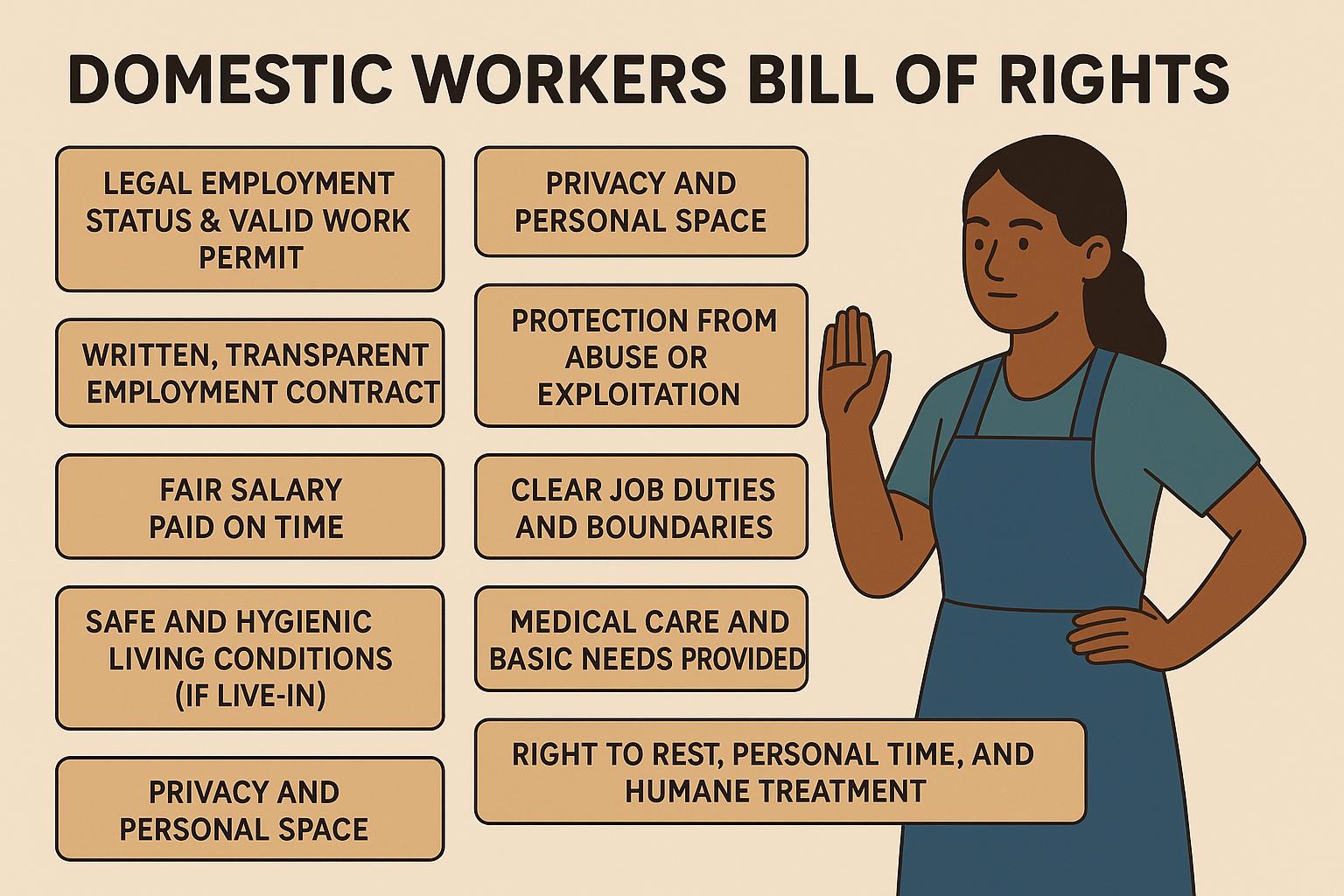
Key Rights to Remember in Domestic Workers Bill of Rights
Here is a summary “check-list” of core rights every domestic helper should have:
- Legal employment status & valid work permit
- Written, transparent employment contract
- Fair salary paid on time
- Reasonable working hours and rest days
- Safe and hygienic living conditions (if live-in)
- Privacy and personal space
- Protection from abuse or exploitation
- Clear job duties and boundaries
- Medical care and basic needs provided
- Right to rest, personal time, and humane treatment
- Respect for personal dignity, beliefs, and identity
Conclusion — A Bill of Rights Means Respect and Stability
A domestic workers bill of rights is not just paperwork — it’s a moral, ethical, and practical foundation for any household that welcomes a helper. When rights are respected, boundaries are clear, and care is mutual, everyone wins: the helper, the employer, and the home as a whole.
Whether you already employ a helper or plan to hire soon — giving attention to rights and fairness from day one builds a relationship based on trust, respect, and long-term harmony.
A home is more than a physical space. It’s a living environment where dignity, respect, and humanity must thrive. A good bill of rights helps make that real.
Related content: